
Rapid BCA Protein Quantification Analysis using the MRX A2000
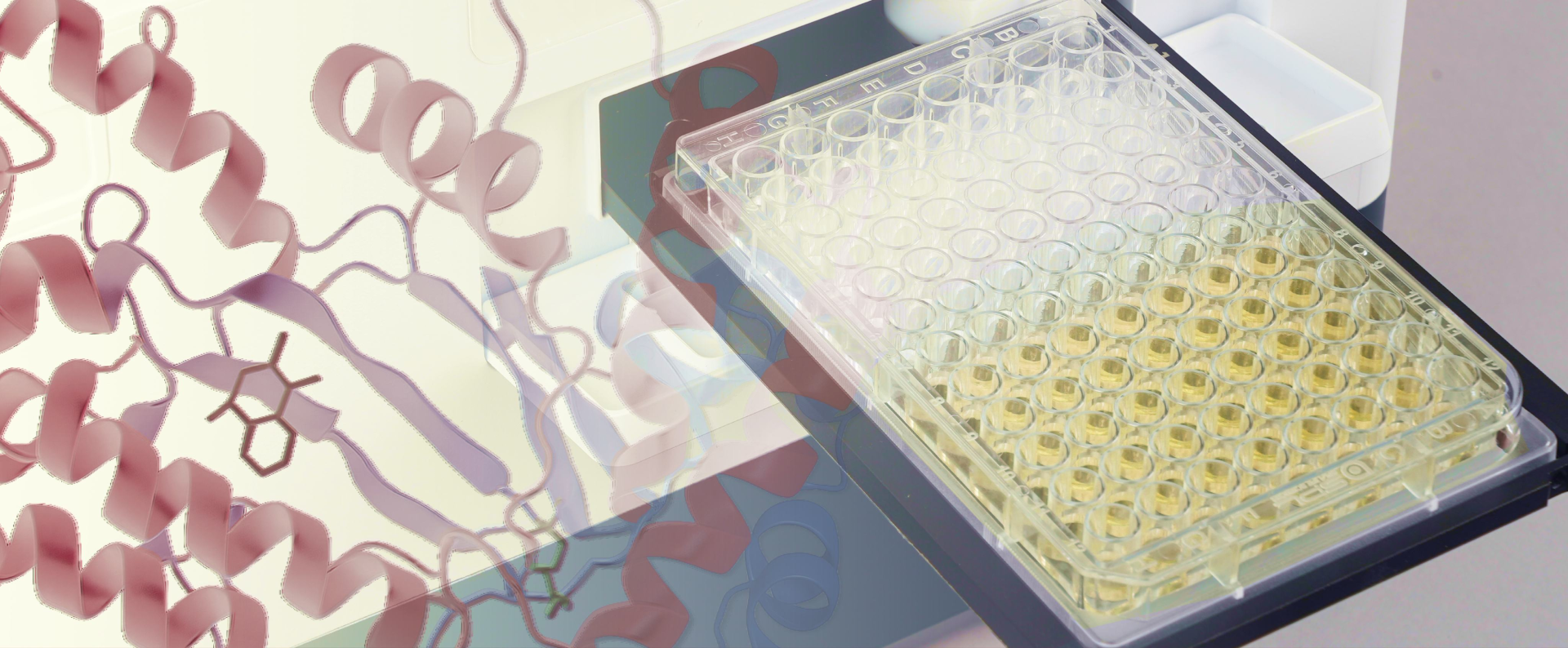
In this experiment, Rapid BCA protein quantification analysis was performed using the automated [Workflow] function of the K LAB MRX A2000 Microplate Reader. BSA standard solutions measured within the 0.125–5.000 mg/mL concentration range exhibited excellent linearity with R² ≥ 0.999 based on a second-order polynomial calibration curve. The %RE based on back-calculated concentrations satisfied accuracy criteria within the range of −8 to +4%, and the %CV was below 6% at all concentrations, confirming high repeatability. Additional observations showed that the Rapid BCA reaction solution exhibited color change over time; however, the MRX’s automated workflow minimized variations in mixing, incubation, and measurement timing, thereby suppressing this effect. These results demonstrate that the MRX A2000 is a suitable automated platform for the Rapid BCA Assay.
Overview
Protein quantification is a fundamental and essential analytical process in life science and bio research. The BCA (Bicinchoninic Acid) protein quantification method is widely used due to its applicability to diverse samples and high accuracy. The Rapid BCA Assay offers a shorter reaction time compared to the conventional BCA method, enabling rapid result confirmation. However, it has the characteristic that operator-to-operator variations, such as reagent dispensing and mixing speed, and incubation deviations, significantly impact result reproducibility.
The purpose of this note is to perform the Rapid BCA Assay using the [Workflow] automation feature of the MRX A2000 Microplate Reader and to evaluate the impact of the automated reagent mixing, incubation, and absorbance measurement process on the assay’s linearity, accuracy (%RE), and precision (%CV). We verified whether the MRX’s automation function can compensate for the time-sensitive nature of the Rapid BCA Assay, thereby supporting more stable and reproducible protein quantification.
Experimental Conditions
1. Equipment Used
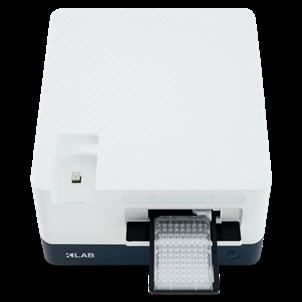
- MRX A2000 Microplate Reader (K LAB)
2. Reagents and Standards
- Pierce™ Dilution-Free™ Rapid Gold BCA Protein Assay Kit (Thermo Fisher Scientific, Cat. No. A55860)
- Bovine Serum Albumin (BSA) Standard Solution (0.125–10 mg/mL, provided pre-diluted tubestrip)
3. Measurement Conditions
- Wavelength: 480 nm
- Reaction Conditions: 5 min incubation at room temperature
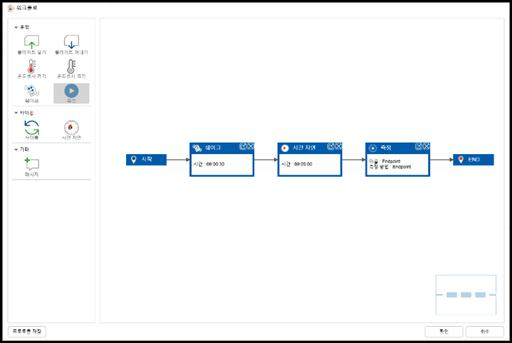
- MRX [Workflow] Settings: Plate shaking (30 seconds, Double orbital) – Incubation (5 minutes) – Absorbance measurement (480 nm)
Experimental Procedure
1. Preparation of Working Reagent (WR)
- Prepare the Working Reagent by mixing Reagent A and Reagent B in a 50:1 ratio. In this experiment, 22 mL of Reagent A and 0.44 mL of Reagent B were mixed and used.
2. Sample Preparation and Measurement Process
- BSA standard solutions (0.125, 0.25, 0.5, 1, 2, 5 mg/mL) were dispensed into a 96-well microplate at 10 µL per well.
- Working Reagent (200 µL) was dispensed into each well using a multichannel pipette. Rapid sequential dispensing was performed to minimize time differences that could occur during sample mixing.
- The well plate was loaded into the measurement compartment of the MRX Microplate Reader, and the pre-set [Workflow] was executed for automated processing.
- Absorbance values were collected for each well, corrected for the blank value, and a standard curve was generated. The experiment was repeated three times using the same method.
Results
1. Curve Fitting
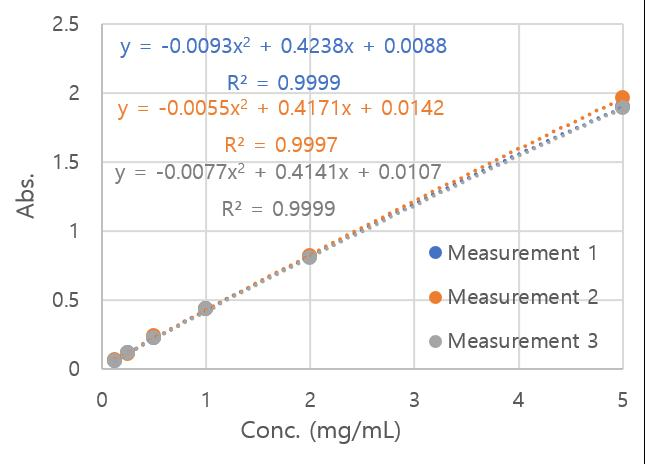
Data measured in the 0.125–5.000 mg/mL range were fitted using a quadratic polynomial. The coefficient of determination (R²) was ≥0.999 in all replicate experiments.
2. Accuracy (%RE)
Back-calculated concentrations were derived from measured absorbance values and compared to standard concentrations to calculate %RE (Relative Error).
Table 1. Back-calculated Concentration and %RE relative to Standard Concentration
| Conc. (mg/mL) | Avg. Measured Abs. | Avg. Back-calculated Conc. (mg/mL) | %RE |
|---|---|---|---|
| 0.125 | 0.0593 | 0.115 | −7.98 |
| 0.250 | 0.1088 | 0.234 | −6.32 |
| 0.500 | 0.2258 | 0.518 | 5.33 |
| 1.000 | 0.4329 | 1.027 | 2.70 |
| 2.000 | 0.8096 | 1.979 | −1.07 |
| 5.000 | 1.9155 | 5.000 | −0.01 |
3. Precision (%CV)
The %CV (Coefficient of Variation) was calculated using three replicate measurements at each concentration.
Table 2. %CV (Precision) at Each Concentration
| Conc. (mg/mL) | %CV |
|---|---|
| 0.125 | 5.9 |
| 0.250 | 3.8 |
| 0.500 | 3.9 |
| 1.000 | 0.5 |
| 2.000 | 1.0 |
| 5.000 | 1.7 |
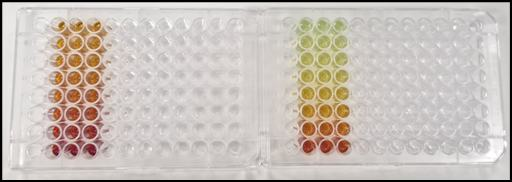
4. Color change of the Rapid BCA Assay reaction solution over time
Additionally, the color change pattern of the reaction solution was observed over time. Immediately after the reaction (at the 5-minute mark), a distinct gradient from yellow to orange was clearly visible, corresponding to the protein concentration. However, when the same plate was photographed 30 minutes later, the color intensity had changed, resulting in a difference from the initial gradient. This visually demonstrates that the passage of time can affect the interpretation of results in the Rapid BCA Assay.
Conclusion
In this experiment, the Rapid BCA Assay was performed using the MRX Microplate Reader. The calibration curve generated in the 0.125–5.000 mg/mL range yielded an R² value greater than 0.999 during quadratic polynomial fitting. The %RE based on back-calculated concentrations ranged from −8% to +4%, and the %CV was less than 6% at all concentrations. Furthermore, by utilizing the MRX’s [Workflow] function to automatically perform reagent mixing, incubation, and absorbance measurement, consistent conditions were maintained between repeated measurements.
References (Source Materials):
- Thermo Fisher Scientific. Pierce™ Dilution-Free™ Rapid Gold BCA Protein Assay Kit User Guide. Pub. No. MAN0029413, Rev. B.0, 26 October 2023.