
Microvolume Protein Quantification Using POP UV-Vis and Pierce™ 660nm Assay

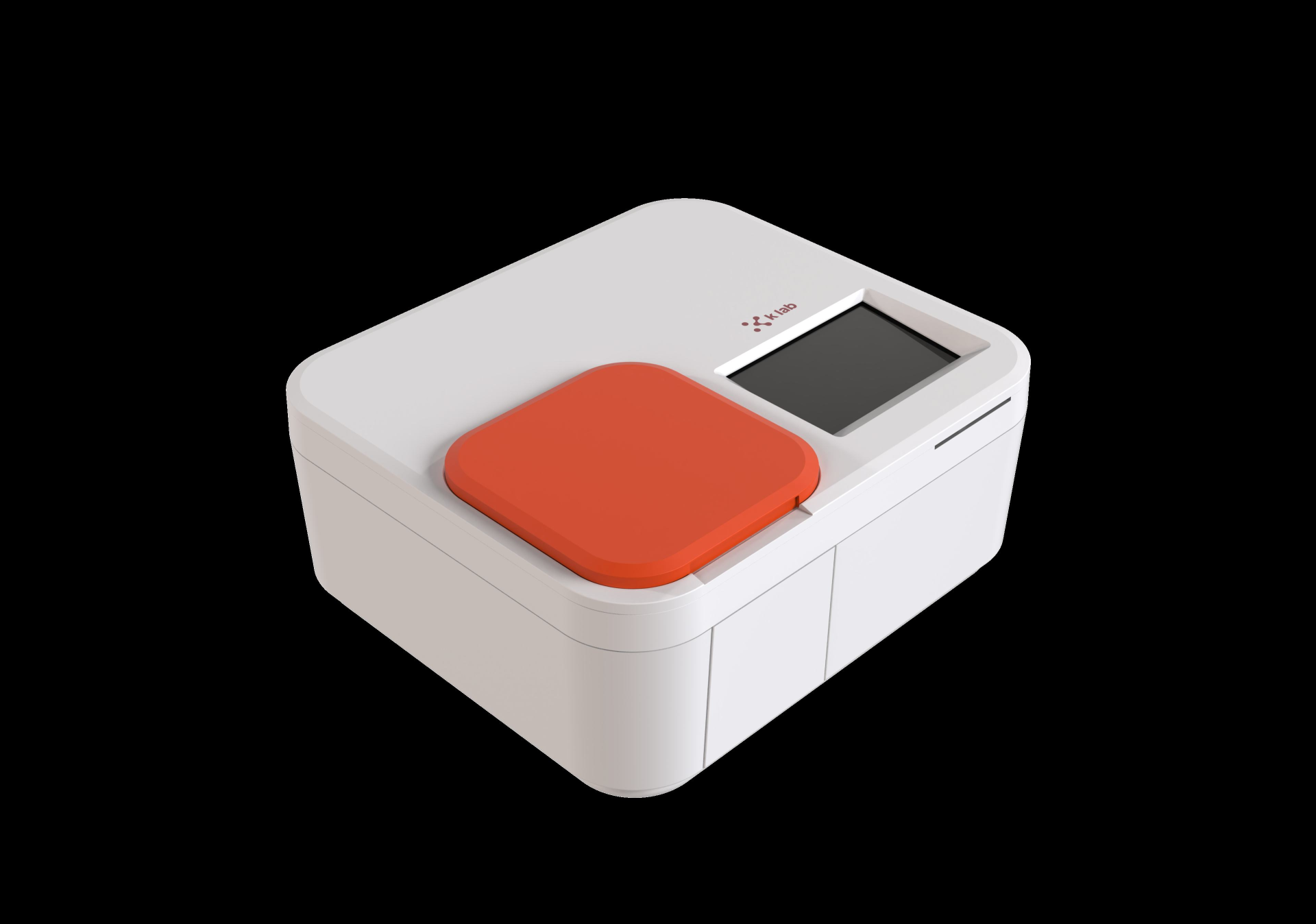
This experiment introduces a micro-volume protein quantification solution using the POP UV-Vis Spectrophotometer from K LAB equipped with a Microvolume Cell Holder, enabling the use of as little as 10 μL of protein sample for the Pierce™ 660 nm Protein Assay. The POP is a standard UV-Vis Spectrophotometer widely used in laboratories and offers flexible cell configurations to suit various analytical purposes, thanks to its compatibility with multiple accessories. When equipped with the Microvolume Cell Holder, it supports the use of disposable micro cuvettes in applications requiring a minimum volume of only 70 μL, making it well-suited for analyzing small-volume samples.
Introduction
This experiment introduces a micro-volume protein quantification solution using the POP UV-Vis Spectrophotometer from K LAB equipped with a Microvolume Cell Holder, enabling the use of as little as 10 μL of protein sample for the Pierce™ 660 nm Protein Assay.
The POP is a standard UV-Vis Spectrophotometer widely used in laboratories and offers flexible cell configurations to suit various analytical purposes, thanks to its compatibility with multiple accessories. When equipped with the Microvolume Cell Holder, it supports the use of disposable micro cuvettes in applications requiring a minimum volume of only 70 μL, making it well-suited for analyzing small-volume samples.
The Pierce™ 660 nm Protein Assay is a colorimetric method that quantifies protein concentration by measuring the absorbance at 660 nm of a blue-colored complex formed through the reaction between the protein and the assay reagent.
Experimental Conditions
Instruments
- POP UV-Vis Spectrophotometer (K LAB, Cat. no: UNT0006)
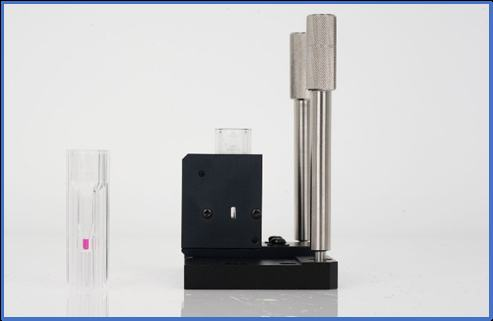
- Microvolume Cell Holder (K LAB, ACC0031)
- Disposable Micro Cuvette (BRAND GMBH, 759200)
- 10 – 1,000 μL pipettors
- 1.5 mL Micro Tube
Reagents
- Protein Standard-analytical standard, 200 mg/mL (BSA) (Sigma, Cat. no: P5369)
- Pierce™ 660 nm Protein Assay Reagent (Thermo Scientific™, Cat. no: 22660)
- Deionized Water (DI Water)
Experimental Procedure
Preparation of BSA Standard Solutions
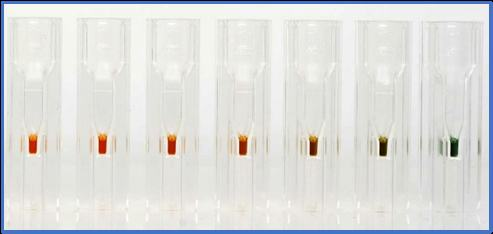
In this experiment, a Protein Standard – analytical standard, 200 mg/mL (Sigma, Cat. no: P5369) was diluted to prepare an initial solution of 2,000 μg/mL. This stock solution was then serially diluted 1:2 to generate a total of six standard solutions with concentrations ranging from 2,000 μg/mL to 62.5 μg/mL.
Preparation of BSA Standard Solutions
- Dispense 10 μL each of the BSA standard solutions and the blank sample into 1.5 mL microtubes. Add 150 μL of Pierce™ 660 nm Protein Assay Reagent (Thermo Scientific™, Cat. no: 22660) to each tube and mix gently.
- Allow the mixtures to react at room temperature for 5 minutes.
- After the reaction, transfer 70 μL of each mixture into a disposable micro cuvette.
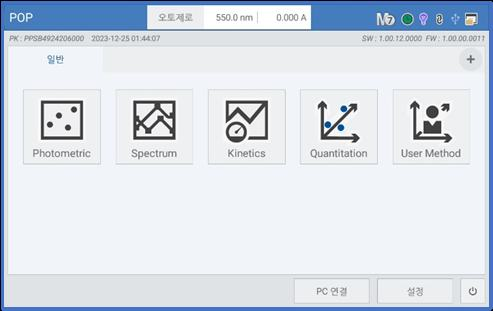
- Select the [Photometric] mode to enter the measurement mode.
- Insert the blank sample into the instrument and set the zero (blank) absorbance.
- Then, sequentially insert each BSA standard solution and measure the absorbance at 660 nm.
Results
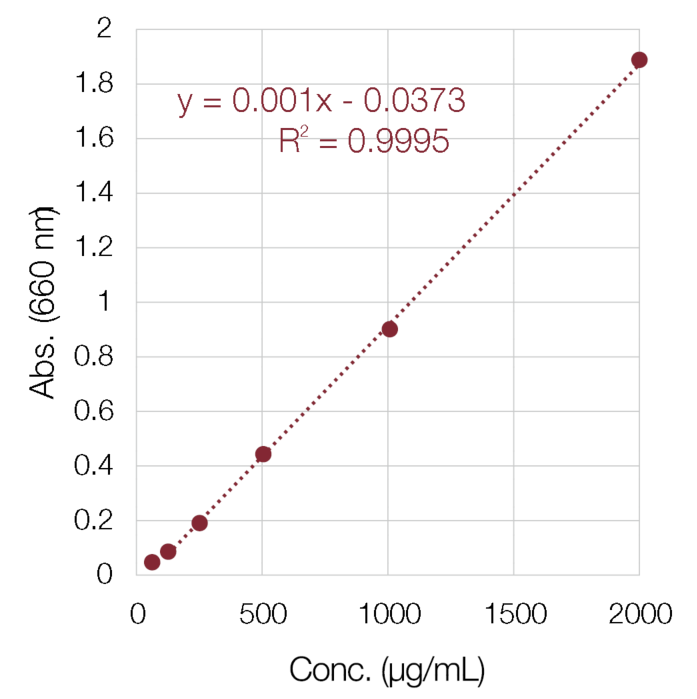
Prepared BSA standard solutions (62.5 – 2,000 μg/mL) using the Pierce™ 660 nm Protein Assay were measured five times each. The results are summarized in [Table 1] and [Figure 5].
Based on the calculated standard deviation and coefficient of variation (%CV), the reproducibility of the assay was evaluated. At the lowest concentration of 62.5 μg/mL, the %CV was 2.2%, and at all other concentrations, %CV values remained below 2.2%, indicating good precision.
In addition, a standard curve generated from absorbance values at 660 nm showed a coefficient of determination (R²) of 0.9995, confirming high linearity across the tested concentration range.
Table 1. Results of five repeated measurements of BSA standard solutions (62.5 – 2,000 μg/mL). %CV was equal to or below 2.2% across all concentrations.
| Conc. (μg/mL) | Conc. (μg/mL) | Standard Deviation | %CV |
|---|---|---|---|
| 62.5 | 0.045 | 0.001 | 2.2% |
| 125 | 0.080 | 0.001 | 1.3% |
| 250 | 0.189 | 0.000 | Below quantifiable variation |
| 500 | 0.447 | 0.001 | 0.2% |
| 1000 | 0.898 | 0.000 | 0.0% |
| 2000 | 1.891 | 0.000 | Below quantifiable variation |
Conclusion
In this study, the performance of the POP UV-Vis Spectrophotometer from K LAB, equipped with a Microvolume Cell Holder, was evaluated for low-volume protein quantification using the Pierce™ 660 nm Protein Assay.
Using 10 μL of protein sample and a 70 μL reaction mixture, repeated measurements showed that the coefficient of variation (%CV) for absorbance was within 2.2%. The standard curve generated from absorbance values measured at 660 nm demonstrated strong linearity, with a coefficient of determination (R²) of 0.9995.
Based on these results, the POP instrument was experimentally confirmed to be suitable for low-volume protein quantification when used in combination with the Pierce™ 660 nm Protein Assay.
References
- – Pierce™ 660 nm Protein Assay Manual (Thermo Scientific, MAN0016386)