
Quantitative Phosphate Analysis Using the SM4500-P E. Method with the Alpha UV-Vis Spectrophotometer

Phosphate is utilized as a key water quality indicator in various environmental and process fields, including wastewater treatment, water purification plant operation, agriculture and fertilizer industries, and drinking water source monitoring. This Application Note applies the widely used phosphate determination method, SM4500-P E (Ascorbic Acid Method), which quantifies phosphorus concentration by measuring the absorbance of molybdenum blue at 880 nm, produced through an ascorbic acid reduction reaction after forming a molybdenum-antimony complex.
Introduction
Phosphate is utilized as a key water quality indicator in various environmental and process fields, including wastewater treatment, water purification plant operation, agriculture and fertilizer industries, and drinking water source monitoring. In particular, the quantitative analysis of phosphorus (P) plays a crucial role in overall environmental management, such as preventing eutrophication in water systems, ensuring process stability, and complying with legal water quality standards.
This Application Note applies the widely used phosphate determination method, SM4500-P E (Ascorbic Acid Method). This procedure quantifies phosphorus concentration by measuring the absorbance of molybdenum blue at 880 nm, produced through an ascorbic acid reduction reaction after forming a molybdenum-antimony complex. Korea’s Ministry of Environment’s Water Pollution Standard Test Method ES04360.2c is also based on the same principle. It distinguishes between the use of a 50 mm long-path cuvette (0.01-0.25 mg P/L) and a 10 mm cuvette (0.15-1.30 mg P/L) depending on the analytical concentration range.
Overview
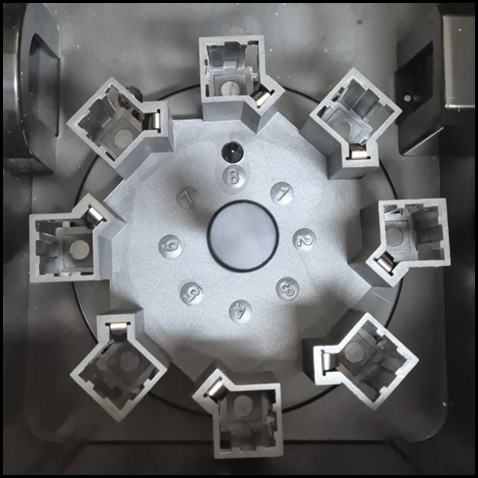
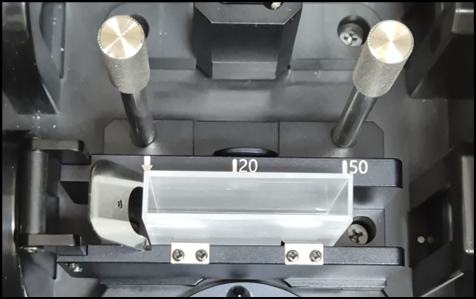
The Alpha UV-Vis spectrophotometer employs a replaceable cell holder structure to accommodate cuvettes of various lengths. Maintaining alignment stability to ensure that the optical path remains unchanged during holder installation is critical. To achieve this, an alignment structure comprising a Cell Holder Base Plate, Locating Pin, Dowel Hole, and Locking Tab is applied. This design ensures that the holder automatically engages with a mechanical reference point. This structure consistently maintains optical-axis alignment during holder replacement or reinstallation, providing a consistent measurement environment even when using cells of different lengths, such as 10 mm and 50 mm cuvettes.
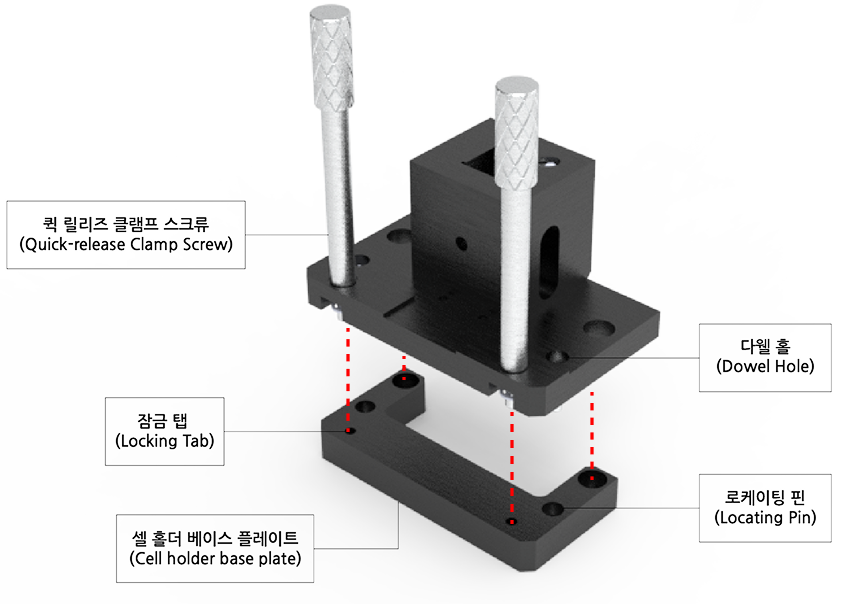
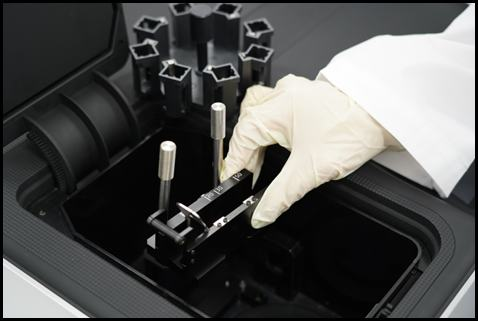
Additionally, the Alpha features a Tool-Free Modular Cell Holder System, enabling quick, tool-free replacement of various cell holder accessories such as 10 mm standard cells, 50 mm long-path cells, micro cuvettes, and round cells. This modular structure reduces experiment preparation time in environments requiring different cuvette formats based on concentration conditions, such as phosphate analysis, and helps maintain stable measurement conditions even after cell holder replacement.
In this study, based on the Alpha’s mechanical and optical structure, standard curves were created and linearity was evaluated for the two concentration ranges (0.01-0.25 mg P/L, 0.15-1.30 mg P/L) required by the SM4500-P E. Ascorbic Acid Method.
Experimental
Preparation of Stock Solution
Potassium phosphate monobasic anhydrous (KH₂PO₄) 0.439 g was accurately weighed using a precision balance, dissolved in distilled water, and made up to volume in a 100 mL volumetric flask. This condition was used to prepare a 1,000 mg P/L standard stock solution based on phosphorus (P), which was subsequently used for stepwise preparation of standard solutions.
Preparation of Standard Solutions at Different Concentrations
Two sets of standard solutions with different concentration ranges were prepared based on the optical path length of the cuvette used for analysis.
For 50 mm long-path cuvettes
- Applicable concentration range: 0.01–0.25 mg P/L
- Preparation concentrations: 0.05, 0.10, 0.15, 0.20, 0.25 mg P/L
For 10 mm cuvettes
- Applicable concentration range: 0.15–1.30 mg P/L
- Working concentrations: 0.15, 0.30, 0.60, 1.00, 1.30 mg P/L
All standard solutions were prepared by stepwise dilution of a 1,000 mg P/L stock standard solution.
Reagent Preparation
Antimony potassium tartrate solution was prepared by dissolving 1.3715 g in distilled water and adjusting the final volume to 400 mL. The ammonium molybdate solution was prepared by dissolving 20 g in distilled water and adjusting to 500 mL. The ascorbic acid solution was prepared by dissolving 1.76 g in distilled water and adjusting to 100 mL.
The Combined Reagent was prepared immediately before use by sequentially mixing 50 mL of 5N sulfuric acid, 5 mL of antimony potassium tartrate solution, 15 mL of ammonium molybdate solution, and 30 mL of ascorbic acid solution to a total volume of 100 mL. The mixed solution was gently stirred to ensure sufficient homogeneity.
Experimental Procedure
① In this experiment, the total reaction volume was reduced to 1/4. Pipette 12.5 mL each of the standard solution at each concentration and distilled water used as the blank. Add 2 mL of Combined Reagent to each and mix thoroughly. The mixed solution was reacted at room temperature for approximately 10 minutes.
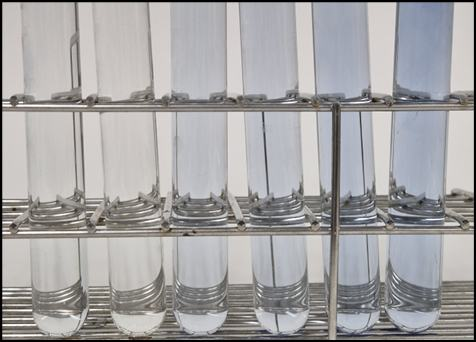
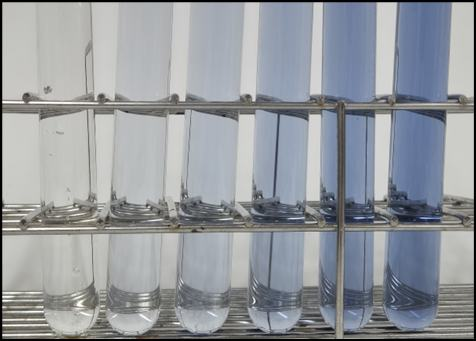
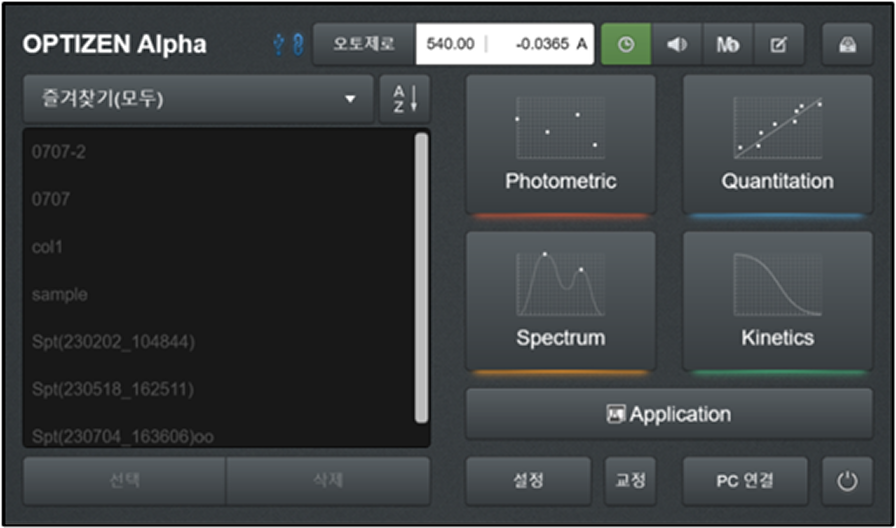
② After transferring the reacted solution to the designated cuvette (10 mm or 50 mm), the absorbance was measured at a wavelength of 880 nm in the [Quantitation] mode of the Alpha.
Results
Using the Alpha UV-Vis spectrophotometer, standard curves were constructed for two concentration ranges (0.01-0.25 mg P/L, 0.15-1.30 mg P/L). The coefficient of determination (R²) exceeded 0.99 in both ranges. The absorbance values measured at each concentration condition increased linearly with increasing concentration, and the constructed standard curves maintained a linear relationship.
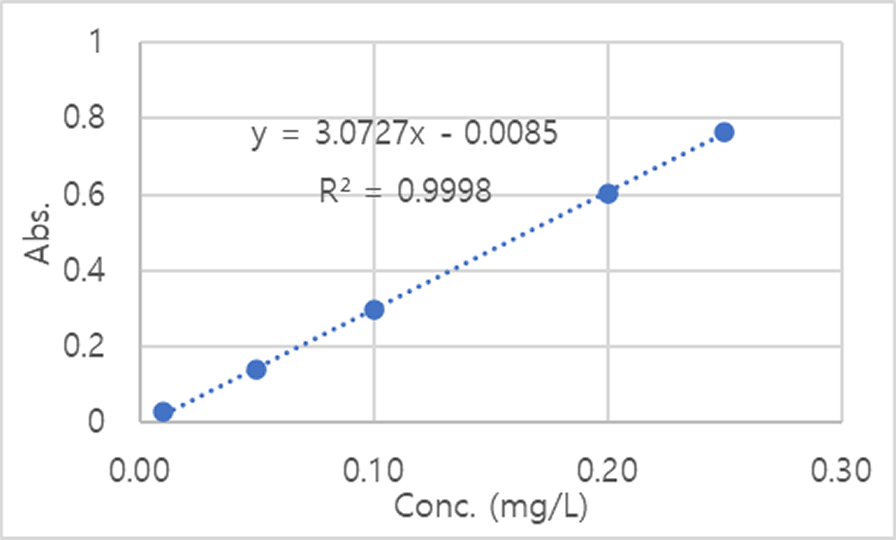
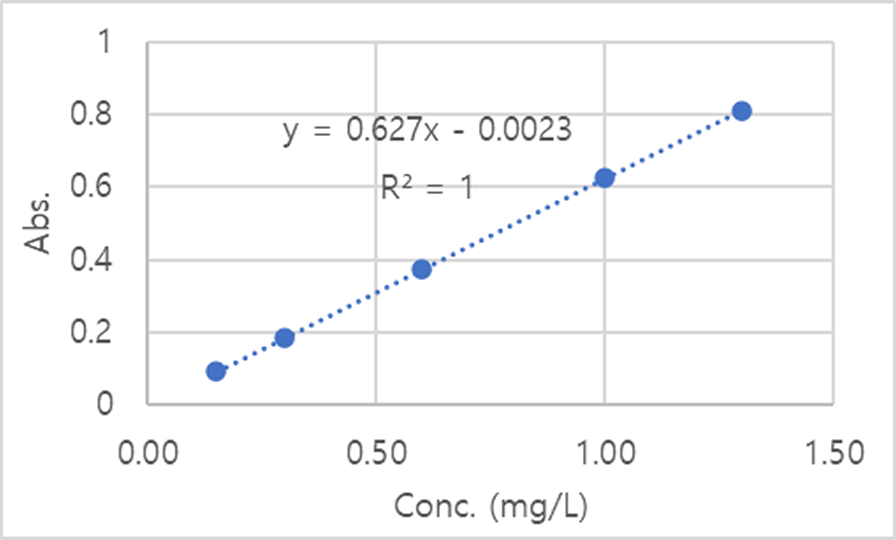
The Alpha supports both the 10 mm and 50 mm cuvette conditions required by the SM4500-P E. Ascorbic Acid Method through its multi-cell holder and long-path cell holder, providing an appropriate measurement environment according to the phosphate concentration range. The standard curves developed for both concentration ranges in this study exhibited linearity with R² values of 0.999 or higher. These results demonstrate that the Alpha UV-Vis Spectrophotometer provides reliable linearity and measurement reproducibility under both the 10 mm and 50 mm path-length conditions required by the SM4500-P E (Ascorbic Acid) Method.
References (Source Materials):
- American Public Health Association, American Water Works Association, and Water Environment Federation. Standard Methods for the Examination of Water and Wastewater. 23rd ed., 2017, pp. 4-156 – 4-165.