
Quantitative Determination of Total Polyphenol Content in Green Tea Powder Based on ISO 14502-1

In this study, the total polyphenol content of a green tea powder used for food manufacturing was quantified using the ISO 14502-1:2005(E) standard analytical method. A 70% methanol extract of the sample was reacted with Folin-Ciocalteu reagent, and the absorbance was measured at 765 nm using the Alpha UV-Vis spectrophotometer, after which the results were expressed as gallic acid equivalents (GAE) based on a gallic acid calibration curve. The calibration curve constructed over the range of 10.0–50.2 µg gallic acid showed excellent linearity, with a correlation coefficient (R²) of 0.9999. These findings demonstrate that total polyphenol analysis performed with the Alpha UV-Vis spectrophotometer is compliant with the ISO 14502-1 test method and can be reliably applied to the quantitative determination of total polyphenols in food-grade raw materials.
Overview
Polyphenols are secondary metabolites of plants and represent an important class of bioactive compounds, exhibiting diverse physiological activities including antioxidant, anticancer, antimicrobial, and cardioprotective effects. In particular, green tea is rich in polyphenols such as catechins and is therefore widely used as a key raw material in functional foods and dietary supplements. Consequently, there is a growing need for analytical methods that can quantify the total polyphenol content of green tea raw materials in an objective and reproducible manner for quality control and functional evaluation.
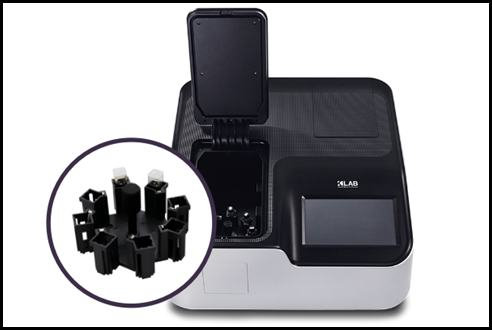
ISO 14502-1:2005(E) is an international standard test method that quantifies the total polyphenol content of tea products, including green and black tea, using the Folin-Ciocalteu reagent, and it is widely employed in both research and industrial settings. In this study, this standard method was applied to a green tea powder intended for food manufacturing, and the linearity and reliability of total polyphenol analysis performed using the K LAB Alpha UV-Vis spectrophotometer were evaluated. Through this, the [Quantitation] mode of the Alpha UV-Vis spectrophotometer was verified as a suitable measurement platform for total polyphenol analysis in accordance with ISO 14502-1 and is proposed as a quantitative analytical solution for raw material quality control and research and development in the food and beverage industry.
Materials and Methods
Sample
The sample used in this study was a green tea powder intended for food manufacturing processes. The product was purchased in sealed form and stored at room temperature until analysis.
Reagents and Standards
- gallic acid (Sigma-Aldrich, analytical grade)
- Folin-Ciocalteu reagent (Sigma-Aldrich)
- sodium carbonate (analytical grade)
- methanol, 70% (v/v, analytical grade)
Experimental Procedure
Sample Extraction
- Accurately weigh 0.200 g of green tea powder into a 15 mL centrifuge tube.
- Preheat 70% methanol to 70°C and add 5 mL of the solvent to the tube containing the sample.
- Seal the tube and place it in a 70°C water bath for 5 min, then remove it and mix using a vortex mixer.
- Return the tube to the 70°C water bath and incubate for an additional 5 min. After incubation, remove the tube and mix again using a vortex mixer.
- After cooling to room temperature, centrifuge at 3,500 r/min for 10 min.
- Transfer the supernatant into a graduated tube.
- Repeat the extraction once using the sample procedure, combine the two extracts, and adjust the final volume to 10 mL with 70% methanol.
- Before analysis, dilute the sample appropriately so that the measured absorbance falls within the calibration range.
Preparation of Standard Solutions
- Accurately weigh 0.100 g of gallic acid and dissolve it in distilled water to prepare a 100 mL stock solution.
- Dilute the stock solution with distilled water to obtain standard solutions with concentrations of 10, 20, 30, 40, 50 µg/mL.
Reaction and Measurement
- Pipette 1 mL each of the standard solutions, the diluted sample solutions, and the blank solution into separate test tubes.
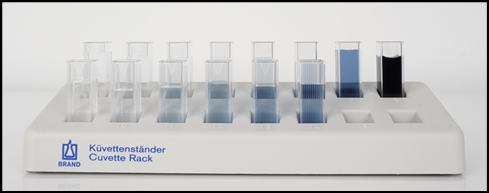
- Add 5 mL of 10-fold diluted Folin-Ciocalteu reagent to each tube. Let the mixture react for 5 min in the dark.
- Add 4 mL of 7.5% sodium carbonate solution and incubate the mixtures for 60 min at room temperature in the dark.
- In the [Quantitation] mode of the Alpha UV-Vis spectrophotometer, enter the standard concentrations (10, 20, 30, 40, and 50 µg/mL) and measure the absorbance at 765 nm.
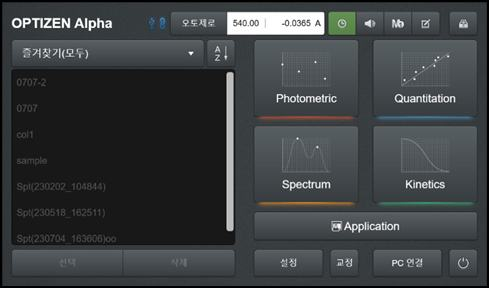
Figure 2. Main screen of the K LAB UV-Vis spectrophotometer – The instrument provides Photometric, Quantitation, Spectrum, and Kinetics modes, and in this study the [Quantitation] mode was used to perform total polyphenol analysis - The absorbance was measured and the calibration curve was constructed in the [Quantitation] mode, and the results obtained from this calibration curve were used to express the total polyphenol content of the samples as gallic acid equivalents (GAE).
Results
Linearity
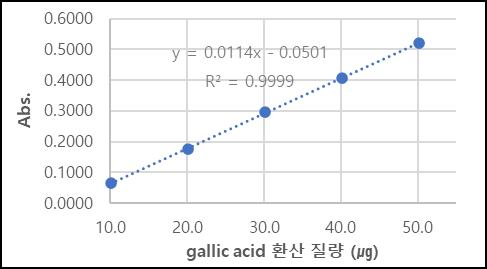
For the linearity assessment, a calibration curve was constructed by plotting the actual mass of gallic acid introduced into the reaction mixture (10.0–50.2 µg) on the x-axis and the mean absorbance at 765 nm from three replicate measurements on the y-axis, after reacting the diluted standard solutions under the ISO 14502-1 conditions. As shown in [Table 1] and [Figure 3], excellent linearity was obtained over the entire range, with a regression equation of y = 0.0114x − 0.0501 and a coefficient of determination(R²) of 0.9999.
Table 1. Absorbance (mean of three measurements) according to the equivalent mass of gallic acid (µg)
| gallic acid Equivalent mass (µg) | Abs. (Average) |
|---|---|
| 10.0 | 0.0653 |
| 20.1 | 0.1757 |
| 30.1 | 0.2958 |
| 40.2 | 0.4066 |
| 50.2 | 0.5217 |
Sample results
The sample was diluted 80-fold and 100-fold so that it fell within the valid calibration range (10.0–50.2 µg). The 80-fold and 100-fold dilutions gave gallic acid equivalent values of 11.9 µg and 10.7 µg, respectively. By back-calculating with the respective dilution factors, the total polyphenol content of the original sample was determined to be 953.7 µg GAE and 1,071.3 µg GAE. The mean value was 1,011.65 µg GAE. When this value was applied to the initial sample weight of 0.2004 g and converted to a 100 g basis, the total polyphenol content of the green tea powder was calculated to be 0.505 g GAE/100 g (w/w).
Table 2. Absorbance at 765 nm and gallic acid equivalent values according to sample dilution factor
| Dilution factor | Abs. (Average) | GAE-equivalent mass (µg) | GAE-equivalent mass of the original sample (µg) |
|---|---|---|---|
| 1 | 4.000 | 355.3 | 353.3 |
| 10 | 0.8120 | 75.6 | 756.1 |
| 80 | 0.0858 | 11.9 | 953.7 |
| 100 | 0.0720 | 10.7 | 1071.3 |
| 200 | 0.0243 | 6.5 | 1305.3 |
Conclusion
By applying the ISO 14502-1:2005(E) standard analytical method to a green tea powder sample intended for food manufacturing, the total polyphenol content could be quantified as gallic acid equivalents (GAE) using the absorbance measured after reaction with the Folin-Ciocalteu reagent and the gallic acid calibration curve. This study demonstrated that the [Quantitation] mode of the K LAB Alpha UV-Vis spectrophotometer enables reliable total polyphenol analysis in accordance with ISO 14502-1 and can be utilized as a quantitative analytical solution for quality control and functional evaluation of green tea raw materials in the food and beverage industry.
*Reference:
- International Organization for Standardization (ISO). ISO 14502-1:2005(E): Determination of substances characteristic of green and black tea — Part 1: Content of total polyphenols in tea — Colorimetric method using Folin-Ciocalteu reagent. ISO, Geneva, Switzerland.