
Identification of Extra Virgin Olive Oil using the Alpha UV-Vis Spectrophotometer

In this study, based on the International Olive Council (IOC) UV spectrophotometric method, the specific extinction coefficients K₂₃₂, K₂₇₀, and ΔK of two commercially available extra virgin olive oils (EVOO), blended olive oil, and sunflower oil samples were measured using the K LAB Alpha UV-Vis spectrophotometer. The UV absorbance of stock solutions and 1:5 diluted solutions prepared in cyclohexane was measured in the ultraviolet region and converted into K values according to the International Olive Council (IOC) calculation formula. The converted results were then compared with the IOC criteria for extra virgin olive oil to evaluate grade compliance.
Overview
Globally, the consumption of olive oil is increasing as a source of healthy fats, with the demand for extra virgin olive oil (EVOO) expanding most rapidly among all categories.
Accordingly, cases have been reported in which the actual quality of olive oil differs from label declarations due to the adulteration with low-cost oils or oxidative degradation. As a result, the need for internationally standardized quality verification methods has been increasingly emphasized.
The International Olive Council (IOC) has established a UV spectrophotometric method that uses the specific extinction coefficients K₂₃₂, K₂₇₀, and ΔK for olive oil grade classification. Absorption characteristics in the ultraviolet region reflect the presence of conjugated diene and triene oxidation products, and are therefore used as key quality indicators for evaluating the degree of oxidation and refining of olive oil.
In this application note, the K₂₃₂, K₂₇₀, and ΔK values of two commercial extra virgin olive oils and other edible oils were measured using K LAB’s Alpha UV-Vis spectrophotometer following the IOC test method. The obtained values were compared with the IOC extra virgin criteria to evaluate the grade suitability of each sample.
Experimental Conditions
Sample Preparation
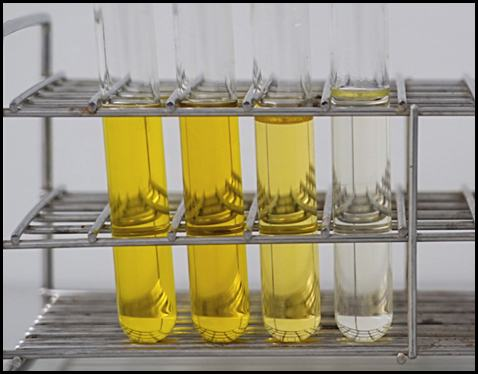
In this experiment, two commercially available extra virgin olive oils (EVOO-1 and EVOO-2), a blended olive oil (OO-1), and a sunflower oil (SO-1) were used as samples. Approximately 0.25–0.30g of each sample was weighed into a 25 mL volumetric flask and diluted to volume with cyclohexane to prepare the stock solution.
To ensure that the absorbance for the K₂₃₂ measurement fell within the recommended range of 0.1–0.8, the same stock solution was further diluted 1/5 with cyclohexane to prepare the diluted solutions. The sample information and the concentrations of the prepared solutions are summarized in [Table 1].
Table 1. Sample information and prepared solution concentrations
| Sample ID | Ingredients on label | Stock conc. (g/100 mL) | Diluted conc. (g/100 mL) |
|---|---|---|---|
| EVOO-1 | Extra virgin olive oil | 1.13 | 0.23 |
| EVOO-2 | Extra virgin olive oil | 1.13 | 0.23 |
| OO-1 | Refined olive oil and virgin olive oil | 1.07 | 0.21 |
| SO-1 | Sunflower oil | 1.01 | 0.20 |
Measurement and Data Processing
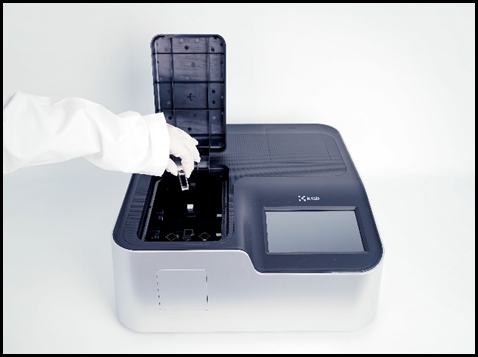
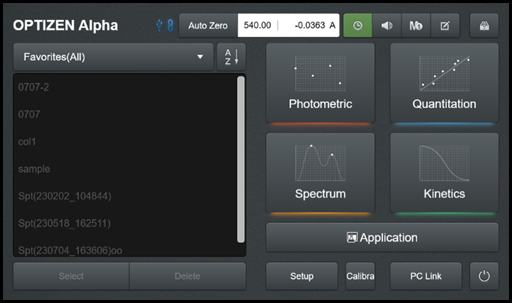
Measurements were performed using the K LAB Alpha UV-Vis spectrophotometer with 10 mm quartz cuvettes. The measurement wavelengths were set to 232, 266, 270, and 274 nm in accordance with the IOC test method, and zero adjustment was carried out using cyclohexane as the blank. Prior to sample analysis, each cuvette was rinsed several times with the same sample to prevent cross-contamination and to ensure a clean measurement surface.
The K₂₃₂, K₂₇₀, and ΔK values obtained for each sample were then compared with the IOC UV standards for extra virgin olive oil and olive oil (refined olive oil + virgin oils) to evaluate compliance with the specified grade criteria.
Table 2. IOC UV standards for selected olive oil types
| Oil type | K₂₃₂ | K₂₇₀ | ΔK |
|---|---|---|---|
| Extra virgin olive oil | ≤ 2.50 | ≤ 0.22 | ≤ 0.01 |
| Olive oil (refined olive oil + virgin oils) | − | ≤ 1.15 | ≤ 0.15 |
The absorbance Aλ obtained at each wavelength was converted to the specific extinction coefficient Kλ according to the calculation formula specified by the IOC. When the cell path length is s and the sample concentration is c (g/100 mL), Kλ is defined as follows. Since a 10 mm quartz cuvette was used in this experiment, s = 1 cm was applied.
Kλ = Aλ / (c × s)
The ΔK value was calculated using the Kλ values at 266, 270, and 274 nm according to the following equation.
ΔK = K270 − (K266 + K274) / 2
Results and Discussion
Table 3 summarizes the K₂₃₂, K₂₆₆, K₂₇₀, K₂₇₄, and ΔK values calculated for each sample using the Alpha UV-Vis spectrophotometer, along with the determination results based on the IOC extra virgin criteria ([Table 2]). The K₂₃₂ value was calculated using the absorbance at 232 nm from the 1/5 diluted sample.
The K₂₃₂ values of EVOO-1 and EVOO-2 were below 2.50, and their K₂₇₀ and ΔK values were within the limits of 0.22 and 0.01, respectively, meeting the IOC criteria for extra virgin olive oil.
In contrast, OO-1 and SO-1 exhibited K₂₃₂, K₂₇₀, and ΔK values higher than the acceptable limits for the extra virgin grade, and therefore did not comply with the IOC extra virgin classification.
Table 3. Kλ values and extra virgin criteria evaluation results by sample
| Sample ID | K₂₃₂ | K₂₆₆ | K₂₇₀ | K₂₇₄ | ΔK | Extra virgin Determination |
|---|---|---|---|---|---|---|
| EVOO-1 | 2.457 | 0.165 | 0.153 | 0.148 | −0.003 | PASS |
| EVOO-2 | 2.357 | 0.197 | 0.194 | 0.191 | 0.000 | PASS |
| OO-1 | 2.853 | 0.480 | 0.489 | 0.437 | 0.031 | FAIL |
| SO-1 | 3.162 | 2.743 | 3.166 | 2.875 | 0.357 | FAIL |
Conclusion
In this experiment, the ultraviolet spectrophotometric method proposed by the IOC was referenced to calculate the K₂₃₂, K₂₇₀, and ΔK values of commercial extra virgin olive oil and other edible oil samples using the Alpha UV-Vis spectrophotometer, and the results were compared with the IOC extra virgin criteria.
Both extra virgin samples satisfied the allowable limits for all three indicators, whereas the blended olive oil and sunflower oil samples exceeded the standard values for every parameter, confirming that they do not meet the extra virgin classification.
These findings demonstrate that the Alpha UV-Vis spectrophotometer is suitable for evaluating the oxidation and refining levels of olive oil using the IOC UV indicators (K₂₃₂, K₂₇₀, ΔK), and that it can be effectively applied in practical quality control and grade verification workflows.
* References
- International Olive Council. Spectrophotometric investigation of the ultraviolet (COI/T.20/Doc. No 19/Rev.5). Madrid: International Olive Council; 2019.
- International Olive Council. Trade standard applying to olive oils and olive pomace oils (COI/T.15/NC No 3/Rev. 13). Madrid: International Olive Council; 2019