
Peroxide value measurement in edible oils
Peroxide is a useful indicator in determining the levels of oxidation in fats and oils. Its level of existence is called peroxide value (PV) and is a measure of total amount of peroxide in a substance. It is one of the main reasons behind the rancidity, production of toxins in edible oils. The autooxidation reaction between atmospheric oxygen and lipids generally leads to oxidative degradation of lipids. Enzymatic, thermal and photo oxidation process are also responsible for oil degradation.
Introduction
Peroxide is a useful indicator in determining the levels of oxidation in fats and oils. Its level of existence is called peroxide value (PV) and is a measure of total amount of peroxide in a substance. It is one of the main reasons behind the rancidity, production of toxins in edible oils. The autooxidation reaction between atmospheric oxygen and lipids generally leads to oxidative degradation of lipids. Enzymatic, thermal and photo oxidation process are also responsible for oil degradation.
Edible oils with high level of PV values have the ability to potentially cause the initiation of degenerative disease, cancers etc. This application note describes a process to analyze PV in edible oils using UV spectrophotometer.
Principle
FeIII XO (XO = Xylenol) complex formation is used to detect the concentration of hydroperoxides. FeIII can be oxidized by H2O2 to FeIII which will sequentially coordinate with XO to yield purplish red FeIII XO complex as shown below
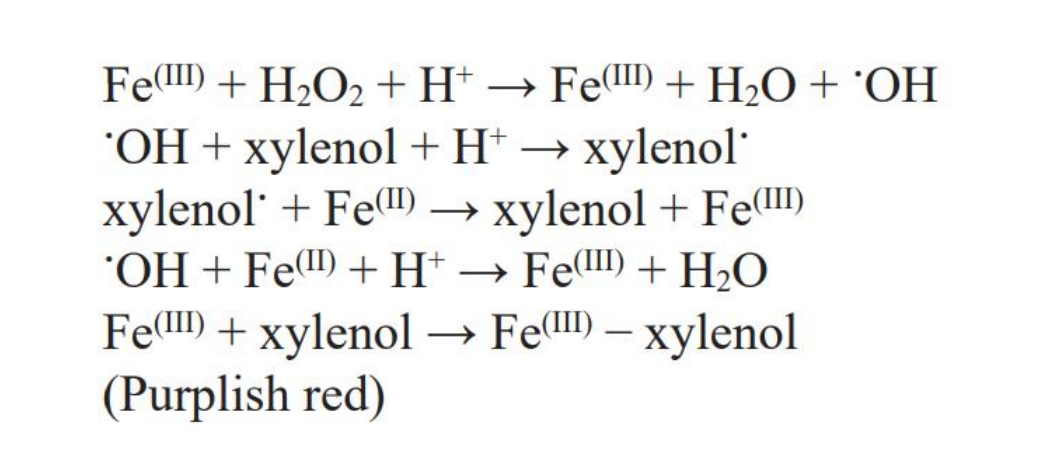
These reactions are fast, sensitive and reproducible. The concentration of H2O2 can usually be determined by spectrophotometrically measuring purplish red color of Fe(III)XO complex in solution.
Reagents
- Xylenol orange sodium salt
- Hydrogen peroxide
- Barium chloride dehydrate
- Ferric chloride solution
- Ferrous sulphate heptahydrate
- Chloroform
- Methanol
- Hydrochloric acid
Preparation of FeIII chloride solution
- 0.5 g FeSO₄, 7 H₂O dissolved in 50 mL of distilled water to prepare an iron sulphate solution.
- Barium chloride (0.4 g) is dissolved in 50 mL of distilled water.
- The resultant solution is added to the FeIII sulphate solution slowly with constant stirring.
- Then, 2 mL of 10 N HCl was added to the solution. Barium sulphate precipitate is formed.
- The barium sulphate precipitate is then filtered off to obtain a clear FeIII solution.
- It is kept in the dark in a brown bottle. The solution is stable for up to 1 month.
Procedure
- Edible oil samples equivalent to ~ 0.2 g are added with 9.8 mL of a mixture of chloroform and methanol (mixed in 7:3 ratio), in capped vials on a vortex mixer for 5 s.
- Then, 100 mL of 10mM xylenol orange is mixed and vortexed for 5 s.
- 50 mL of 36 mM FeIII solution is added and mixed on a vortex mixer for 5 s.
- After 5 min of incubation at room temperature, the absorbance of the sample is determined at 560 nm by a UV-Vis spectrophotometer.
Calibration curves for 2 – 40 µg/mL FeIII are prepared by the use of 100 µL xylenol orange.