
NanoQ Applied to Seasonal Endophytic Bacteria Research in European Beech Leaves
NanoQ Applied to Seasonal Endophytic Bacteria Research in European Beech Leaves
This Research Highlight introduces a published study demonstrating the use of the K LAB NanoQ microvolume spectrophotometer for genomic DNA purity assessment in plant microbiome research.
The study, published in hysiologia Plantarum (2026), investigated the seasonal dynamics of endophytic bacterial communities in European beech (Fagus sylvatica) leaves using PNA Clamp-assisted 16S rRNA gene sequencing.
This Research Highlight explains how the NanoQ microvolume spectrophotometer was applied as a quality-control tool for DNA purity assessment prior to PCR amplification and sequencing.
Research Background and Purpose
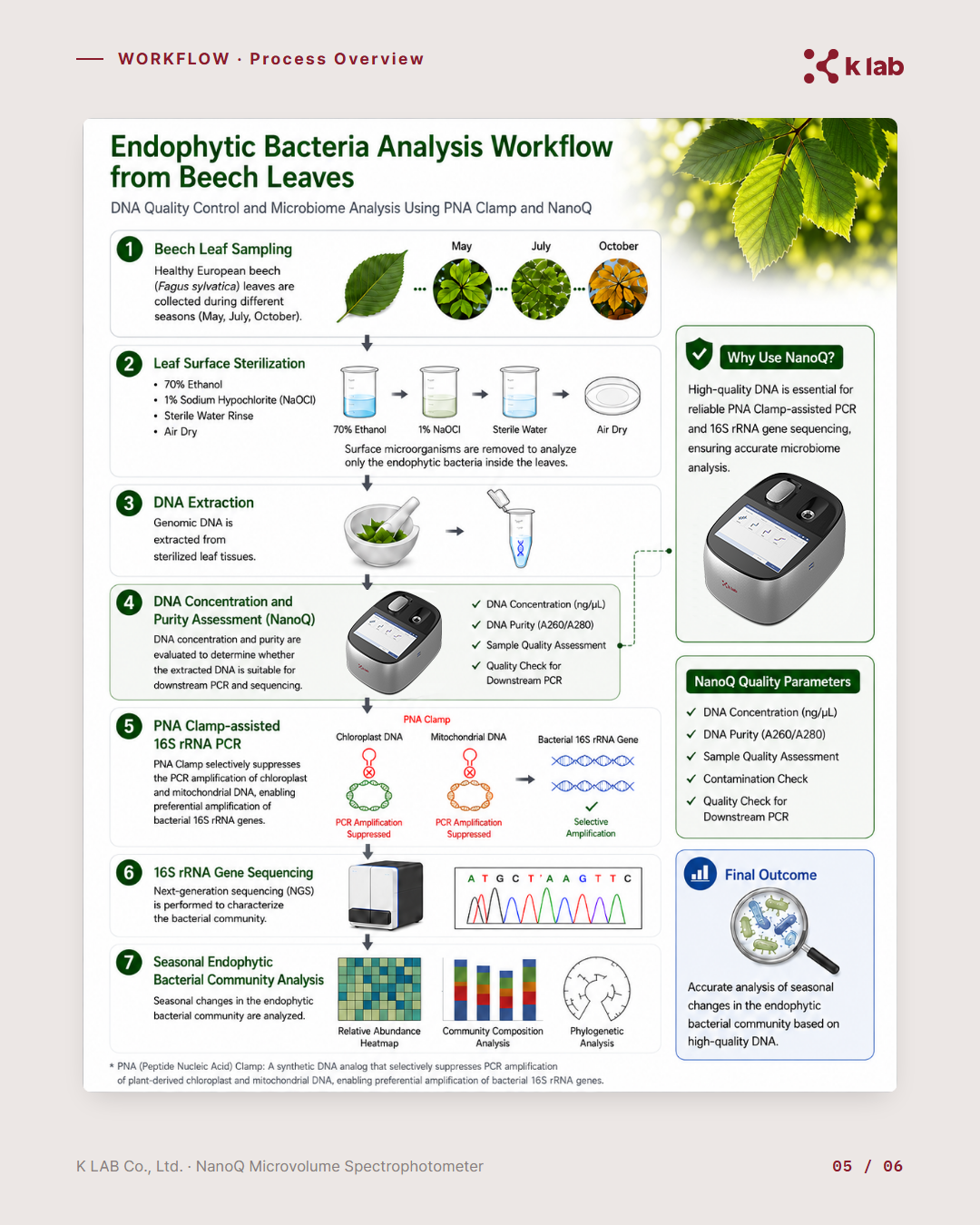
Plant microbiome studies using next-generation sequencing (NGS) are often affected by co-amplification of host-derived DNA, including chloroplast and mitochondrial DNA, which can interfere with bacterial community analysis.
To improve bacterial detection, this study applied PNA clamps to selectively suppress amplification of host DNA and compared PNA-treated and untreated samples collected from European beech leaves during May, July, and October to investigate seasonal changes in endophytic bacterial communities.
Equipment Application
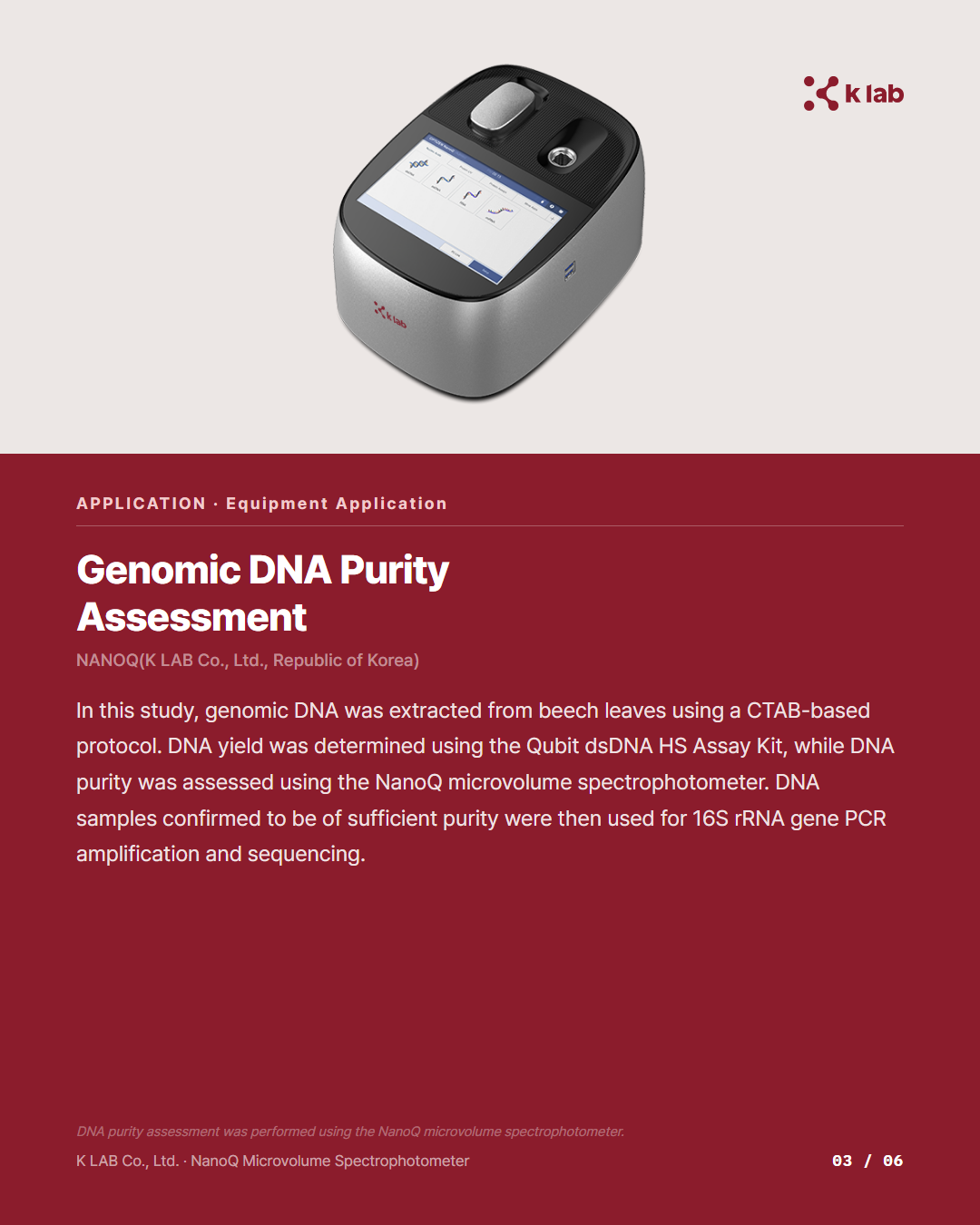
The NanoQ microvolume spectrophotometer was used to assess the purity of genomic DNA extracted from European beech leaves following CTAB-based DNA extraction.
DNA concentration was quantified using the Qubit dsDNA HS Assay Kit, while DNA purity was evaluated using the NanoQ spectrophotometer by measuring the A260/A280 absorbance ratio.
Only DNA samples that met the purity criteria were subsequently used for 16S rRNA gene PCR amplification and sequencing, ensuring reliable downstream microbiome analysis.
Assay Overview
Nucleic acids absorb ultraviolet light at 260 nm, whereas proteins exhibit maximum absorbance near 280 nm.
The ratio of these absorbance values (A260/A280) is widely used to evaluate DNA purity, with a value of approximately 1.8 generally indicating highly purified genomic DNA.
In this study, spectrophotometric DNA purity assessment using NanoQ served as an essential quality-control step prior to PCR amplification and 16S rRNA gene sequencing.
Published Equipment Use Case
This Research Highlight presents a published example of the K LAB NanoQ microvolume spectrophotometer being used in peer-reviewed plant microbiome research.
The study demonstrates that NanoQ can be applied for spectrophotometric DNA purity assessment to support reliable PCR amplification and next-generation sequencing workflows.
For more information about NanoQ microvolume spectrophotometers or DNA quality assessment, please contact K LAB Co., Ltd.
Read the Publication
Giubilei, I. et al. (2026).
Clearing the Noise: Seasonal Dynamics of Endophytic Bacteria in Fagus sylvatica Leaves Revealed by Application of PNA Clamps.
Physiologia Plantarum.