
MRX A2000 Applied to High-Quality Alginate Production from Saccharina japonica By-products
MRX A2000 Applied to High-Quality Alginate Production from Scaccharina japonica By-products
This Research Highlight introduces a published study demonstrating the use of the K LAB MRX A2000 microplate reader for quantitative carbohydrate, polyphenol, and antioxidant activity analyses during alginate production from Saccharina japonica by-products.
The study, published in the Korean Journal of Fisheries and Aquatic Sciences (2025), investigated pigment-removal processes for producing high-quality alginate from kelp processing by-products by comparing extraction yield, color characteristics, carbohydrate content, polyphenol content, and antioxidant activities.
This Research Highlight explains how the MRX A2000 microplate reader was applied for absorbance-based quantitative assays to evaluate alginate quality under different pigment-removal conditions.
Research Background and Purpose
Large amounts of kelp processing by-products (pomace) are generated during Saccharina japonica processing, creating environmental and economic burdens. Although kelp contains approximately 40% alginate on a dry-weight basis, Korea continues to rely heavily on imported marine biopolymers such as alginate and collagen, highlighting the need to develop high-value domestic production technologies.
This study compared three pigment-removal conditions—no pigment removal (UAT), activated carbon treatment (UATC), and ethanol treatment (UATE)—during ultrasonic-assisted alginate extraction. Extraction yield, color values, total carbohydrate content, total polyphenol content, and antioxidant activities (ABTS, DPPH, and hydrogen peroxide scavenging) were evaluated to identify an optimized process for producing high-quality alginate suitable for food, cosmetic, and pharmaceutical applications.
Equipment Application
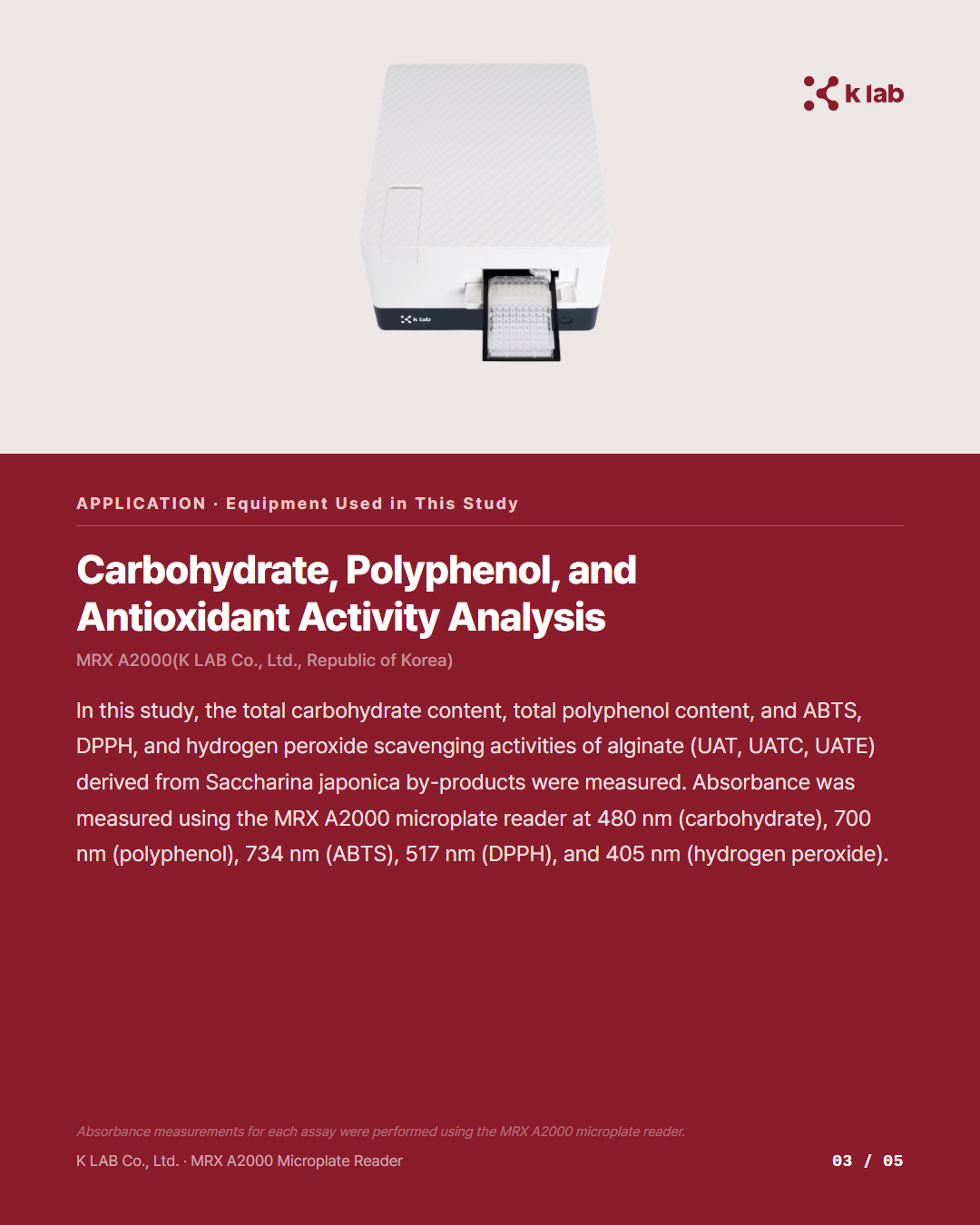
The MRX A2000 microplate reader was used to perform absorbance measurements for quantitative carbohydrate, polyphenol, and antioxidant activity assays of alginate samples obtained under different pigment-removal conditions.
Total carbohydrate content was determined using the phenol-sulfuric acid method at 480 nm, while total polyphenol content was quantified using the Folin-Denis method at 700 nm. Antioxidant activities were evaluated by measuring ABTS radical scavenging activity at 734 nm, DPPH radical scavenging activity at 517 nm, and hydrogen peroxide scavenging activity at 405 nm.
The absorbance data obtained using the MRX A2000 enabled quantitative comparison of alginate quality characteristics, allowing the researchers to evaluate the effectiveness of each pigment-removal process.
Assay Overview
Alginate quality was evaluated using a series of colorimetric assays based on absorbance measurements.
Total carbohydrate content was quantified by measuring the colored reaction product generated by the phenol-sulfuric acid method and comparing it with a D-glucose standard curve. Total polyphenol content was determined using the Folin-Denis assay with a gallic acid calibration curve.
Antioxidant activities were assessed by monitoring changes in absorbance following reactions between the alginate samples and ABTS radicals, DPPH radicals, or hydrogen peroxide. The measured absorbance values were converted into antioxidant scavenging activities according to the calculation method of each assay.
Published Equipment Use Case
This Research Highlight presents a published example of the K LAB MRX A2000 microplate reader being used in peer-reviewed marine biomaterial research.
The study demonstrates that the MRX A2000 can be applied for absorbance-based quantitative assays, including carbohydrate analysis, polyphenol determination, and antioxidant activity measurements, to evaluate the quality of alginate produced under different processing conditions.
For more information about the MRX A2000 microplate reader or absorbance-based analytical applications, please contact K LAB Co., Ltd.
Read the Publication
Do-Young Jung, Mi-Ra Lee, Yu-ri Choe et al. (2025).
Development of a High-quality Alginate Production Process Using Saccharina japonica By-products with Antioxidant Properties.
Korean Journal of Fisheries and Aquatic Sciences.