
Hexavalent Chromium (Cr(VI)) Analysis in Soil Using a POP UV-Vis Spectrophotometer – ES 07408.1b Diphenylcarbazide Method

Hexavalent chromium (Cr(VI)) in soil can be introduced through various industrial activities and is therefore considered an important target analyte in soil contamination assessment and environmental monitoring. Accordingly, standardized analytical methods have been established for the quantitative determination of Cr(VI) in soil. In the Soil Contamination Standard Test Method (ES 07408.1b), ultraviolet–visible (UV–vis) spectrophotometry based on the diphenylcarbazide (DPC) color reaction is specified as the quantitative analytical method for Cr(VI). In this method, Cr(VI) is quantified by measuring the absorbance of the Cr(VI)–DPC complex formed under acidic conditions.
Overview
Hexavalent chromium (Cr(VI)) in soil can be introduced through various industrial activities and is therefore considered an important target analyte in soil contamination assessment and environmental monitoring. Accordingly, standardized analytical methods have been established for the quantitative determination of Cr(VI) in soil. In the Soil Contamination Standard Test Method (ES 07408.1b), ultraviolet–visible (UV–vis) spectrophotometry based on the diphenylcarbazide (DPC) color reaction is specified as the quantitative analytical method for Cr(VI). In this method, Cr(VI) is quantified by measuring the absorbance of the Cr(VI)–DPC complex formed under acidic conditions.
In this application note, a calibration curve was constructed using Cr(VI) standard solutions in the range of 0.0125–0.2003 mg/L based on the analytical principle and measurement conditions described in the test method. Absorbance measurements were performed using a POP UV–Vis spectrophotometer. The linearity of the calibration curve, expressed as the coefficient of determination (R²), and the repeatability of the response factor (RF), expressed as % relative standard deviation (%RSD), were evaluated. Through this evaluation, the applicability of the POP UV–Vis spectrophotometer for absorbance-based quantitative analysis of Cr(VI) using the diphenylcarbazide color reaction was demonstrated.
Experiment
Reagents and Materials
- potassium dichromate (K₂Cr₂O₇, Merck)
- sym-Diphenylcarbazide (1,5-diphenylcarbazide, SAMCHUN)
- sulfuric acid
- acetone
- Deionized water (DI water)
Preparation of Cr(VI) Stock Solution and Standard Solutions
The Cr(VI) stock solution was prepared using potassium dichromate. The reagent accurately weighed (0.2833 g), dissolved, and diluted to a final volume of 100 mL with DI water to obtain a stock solution with a concentration of approximately 1001.54 mg/L.
This stock solution was subsequently diluted stepwise with DI water to prepare an intermediate standard solution with a concentration of approximately 1.0015 mg/L.
Using this intermediate standard solution, a series of working standard solutions (STD1–STD5) with concentrations in the range of 0.0125–0.2003 mg/L were prepared. The preparation conditions for each concentration are summarized in Table 1.
Table 1. Preparation conditions for Cr(VI) standard solutions
| Sample | Volume of 1.0015 mg/L standard solution (mL) | Volume of DI water (mL) | Final concentration (mg/L) |
|---|---|---|---|
| STD1 | 0.5 | 39.5 | 0.0125 |
| STD2 | 0.8 | 39.2 | 0.0200 |
| STD3 | 2.0 | 38.0 | 0.0501 |
| STD4 | 4.0 | 36.0 | 0.1002 |
| STD5 | 8.0 | 32.0 | 0.2003 |
Preparation of Diphenylcarbazide (DPC) and Sulfuric Acid Solutions
For the colorimetric reaction of Cr(VI), diphenylcarbazide (DPC) reagent and acidic conditions were prepared. A total of 0.500 g of sym-diphenylcarbazide was accurately weighed, dissolved, and diluted to a final volume of 100 mL with acetone to prepare a 0.5% (w/v) DPC solution. The reagent was prepared immediately before use and stored under light-protected conditions.
To establish acidic conditions, a sulfuric acid solution of approximately 20% (v/v) was prepared using 95% sulfuric acid. As heat is generated during dilution, the solution was sufficiently cooled before final volume adjustment.
Color Development and Measurement Procedure
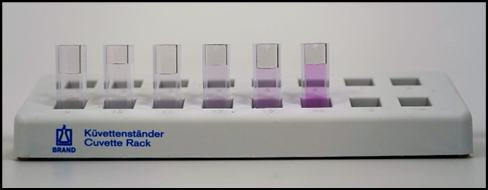
To each Cr(VI) standard solution, 20% (v/v) sulfuric acid solution was added, followed by the addition of 0.5% (w/v) diphenylcarbazide (DPC) solution. After mixing, the solution was allowed to react for approximately 5 min at room temperature to form a purple Cr(VI)–DPC complex.
Instrumentation and Measurement Conditions
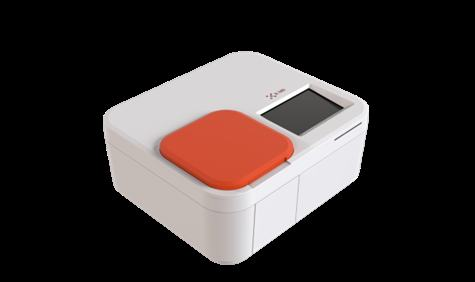
Absorbance measurements of the Cr(VI)–diphenylcarbazide complex were performed using a POP UV–Vis spectrophotometer. The instrument was allowed to warm up for approximately 30 min prior to measurement. Absorbance was measured at 540 nm, the maximum absorption wavelength of the complex formed during the color reaction.
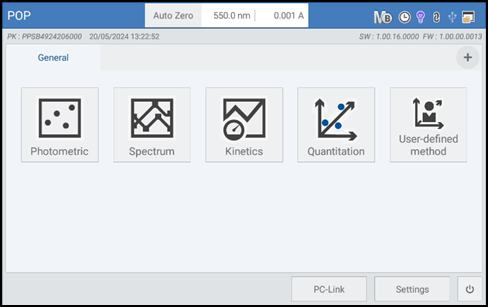
Absorbance measurements were conducted using the Quantitation mode of the POP UV–Vis spectrophotometer, and the results were used to construct the calibration curve.
Results
Absorbance at 540 nm was measured for Cr(VI) standard solutions (0.0125–0.2003 mg/L) under diphenylcarbazide color reaction conditions based on the Soil Contamination Standard Test Method (ES 07408.1b). The response factor (RF) calculated at each concentration level is presented in Table 2.
Table 2. Absorbance and response factor (RF) of Cr(VI) standard solutions
| Sample | Final concentration (mg/L) | Abs. (540 nm) | RF |
|---|---|---|---|
| STD1 | 0.0125 | 0.008 | 0.639 |
| STD2 | 0.0200 | 0.014 | 0.699 |
| STD3 | 0.0501 | 0.036 | 0.719 |
| STD4 | 0.1002 | 0.069 | 0.689 |
| STD5 | 0.2003 | 0.138 | 0.689 |
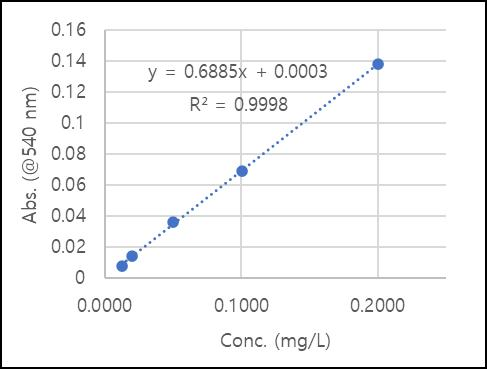
Linear regression analysis of the calibration data produced the calibration equation y = 0.6885x + 0.0003, with a coefficient of determination (R²) of 0.9998.
Conclusion
The calibration curve constructed for Cr(VI) standard solutions (0.0125–0.2003 mg/L) showed a coefficient of determination (R²) of 0.9998, while the relative standard deviation of the response factor (RF) was calculated as 1.75%. These results meet the acceptance criteria for both the linearity (R² ≥ 0.98) and the response factor variation (≤ 20%) specified in the Soil Contamination Standard Test Method (ES 07408.1b).
References
- National Institute of Environmental Research. Soil Contamination Standard Test Method Quality Assurance and Quality Control (QA/QC), ES 07001.a.
- National Institute of Environmental Research. Soil Contamination Standard Test Method: Hexavalent Chromium (Cr(VI)) , ES 07408.1b.