
Preliminary Kinetic Turbidimetric Endotoxin Testing Using the Endotoxin Mode of the MRX Microplate Reader

This study was conducted as a preliminary evaluation of the Bacterial Endotoxin Test (BET) using the turbidimetric method, one of the optical analysis methods described in Appendix 5, General Tests of the Korean Pharmacopoeia (KP). Endotoxins are components of lipopolysaccharides (LPS) found in the outer membrane of Gram-negative bacteria, with Lipid A being primarily responsible for their toxic effects. When introduced into the body, endotoxins may cause fever, inflammation, and septic shock.
Overview
This study was conducted as a preliminary evaluation of the Bacterial Endotoxin Test (BET) using the turbidimetric method, one of the optical analysis methods described in Appendix 5, General Tests of the Korean Pharmacopoeia (KP). Endotoxins are components of lipopolysaccharides (LPS) found in the outer membrane of Gram-negative bacteria, with Lipid A being primarily responsible for their toxic effects. When introduced into the body, endotoxins may cause fever, inflammation, and septic shock.
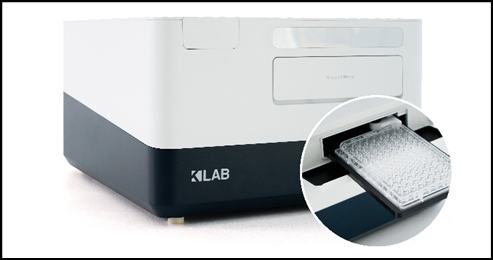
In this study, Pyrotell®-T reagent and Control Standard Endotoxin (CSE) supplied by Associates of Cape Cod, Inc. were used. Measurements were performed using a K LAB microplate reader equipped with a dedicated Endotoxin mode. The assay was carried out using the kinetic turbidimetric method at 37°C.
The experimental design was based on the preliminary test requirements described in KP 44. Assay suitability was evaluated by examining the calibration curve, precision and recovery, and the response of the negative control according to the acceptance criteria specified in the pharmacopoeia.
Materials and Methods
Materials
(1) Reagents
- CSE (Control Standard Endotoxin), Associates of Cape Cod, Inc., E0005-1
- Pyrotell®-T (Turbidimetric LAL Reagent), Associates of Cape Cod, Inc., T005-1
- LRW (LAL Reagent Water), Associates of Cape Cod, Inc., WP100C
(2) Equipment and Consumables
- MRX Microplate Reader, K LAB, UNT0001
- MRX View Software – Endotoxin Mode, K LAB
- Pyroplates® (96-well Microplate), Associates of Cape Cod, Inc., CA961-10
- Precision Pipette Tips (Pyroclear®), Associates of Cape Cod, Inc., PPT10, PPT25
- Disposable Sterile Conical Tube (endotoxin free)
Test Procedure
(1) Preparation of Standard Solutions
LAL Reagent Water (LRW) was added to a Control Standard Endotoxin (CSE) vial to obtain a final concentration of 1,200 EU/mL. The solution was then diluted to 50 EU/mL, followed by a series of 1:10 serial dilutions to prepare calibration standards at concentrations of 5, 0.5, 0.05, and 0.005 EU/mL. All dilutions were performed using LRW.
(2) Preparation of Test Samples
Test samples were prepared by diluting the 1,200 EU/mL CSE stock solution to a concentration of 1.0 EU/mL. An additional 0.1 EU/mL sample was prepared by further diluting the 1.0 EU/mL solution at a 1:10 ratio. These two solutions were used as product samples for the assay.
Sample Layout and Configuration
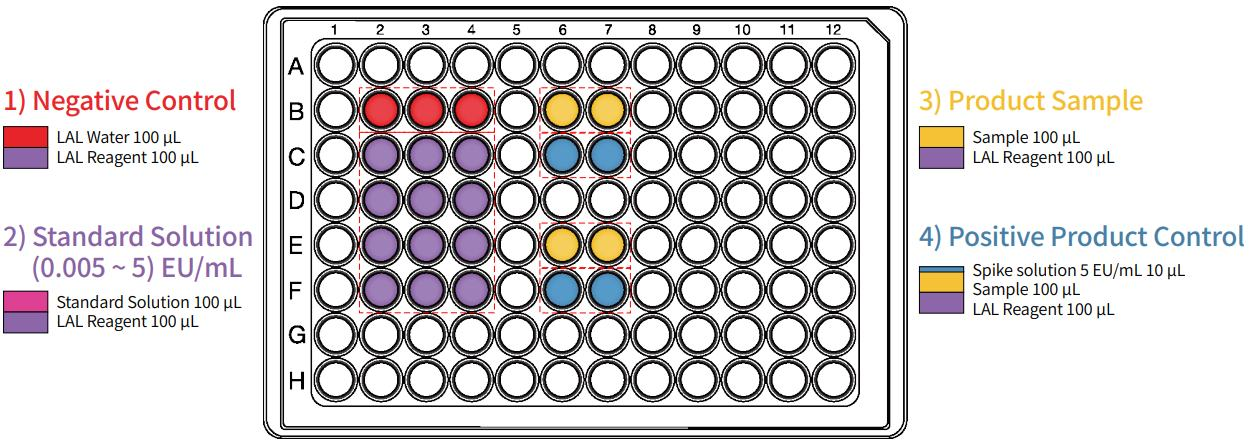
Each sample was dispensed into a 96-well microplate at a volume of 100 µL per well, followed by the addition of an equal volume of Pyrotell®-T reagent, for a total volume of 200 µL per well.
The experiment included a Negative Control, Standard Solutions, Product Samples, and Positive Controls. All test conditions were measured in duplicate or greater to ensure adequate precision. The overall sample layout is shown in Figure 2.
Instrument Operation Procedure
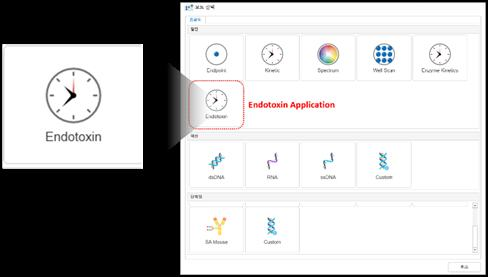
After entering the Endotoxin mode of the MRX microplate reader, the measurement time was set to 2 hours, the reading interval to 30 seconds, and the threshold value to 0.1. The plate layout was then configured as shown in Figure 2, and the measurement was initiated to begin the analysis.
Results
In this study, the preliminary test items were evaluated in accordance with the Bacterial Endotoxin Test (BET) criteria specified in KP 44 of the Korean Pharmacopoeia including standard curve linearity, precision (%CV), recovery rate (%), and the response of the negative control.
Linearity
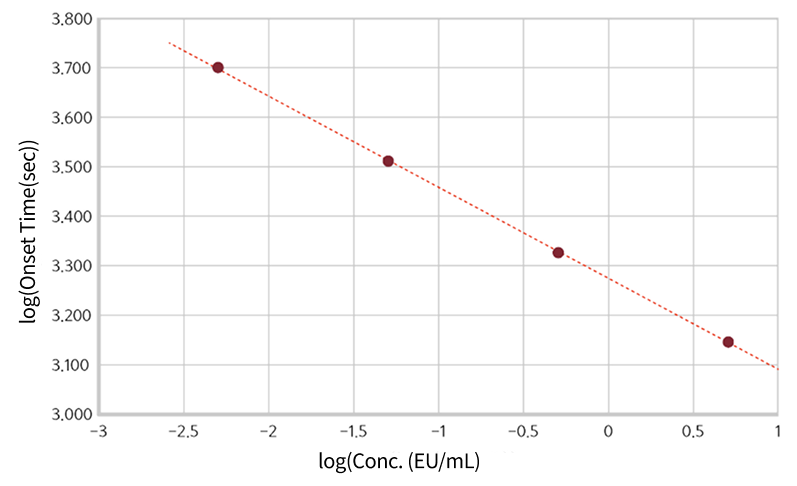
A standard curve was generated using log-log transformed data over four concentration levels (5, 0.5, 0.05, and 0.005 EU/mL). As shown in Figure 4, excellent linearity was obtained, with a correlation coefficient (R) of 1.0000, meeting the Korean Pharmacopoeia acceptance criterion (IRI ≥ 0.98).
Precision
The standard deviation (SD) and coefficient of variation (%CV) were calculated from the replicate onset time measurements at each concentration level. All %CV values were below 10%, meeting the precision requirement.
Table 1. Precision results based on onset time(%CV)
| Conc. (EU/mL) | 1st | 2nd | 3rd | Mean | SD | %CV |
|---|---|---|---|---|---|---|
| Onset time(sec) | Onset time(sec) | Onset time(sec) | Onset time(sec) | Onset time(sec) | Onset time(sec) | Onset time(sec) |
| 0.005 | 4,740 | 5,250 | 4,980 | 4,990 | 255 | 5.1% |
| 0.05 | 3,240 | 3,240 | 3,240 | 3,240 | 0 | 0.0% |
| 0.5 | 2,070 | 2,190 | 2,100 | 2,120 | 62 | 2.9% |
| 5 | 1,350 | 1,440 | 1,410 | 1,400 | 46 | 3.3% |
Recovery (%)
PPC recovery (%) was evaluated for product samples at 1.0 EU/mL and 0.1 EU/mL. Both concentrations satisfied the Korean Pharmacopoeia acceptance criterion of 50–200%.
Table 2. PPC recovery(%) results for product samples
| Conc. (EU/mL) | PPC Recovery% | ||
|---|---|---|---|
| 1st | 2nd | Mean | |
| 1.0 | 79.26 | 87.82 | 83.5 |
| 0.1 | 109.70 | 130.98 | 120.3 |
Negative Control Results
The Negative Control was prepared using LAL Reagent Water (LRW). The onset times were 7,020, 6,960, and 7,020 seconds, with an average onset time of 7,000 seconds. This response occurred later than the average onset time of the 0.005 EU/mL sample (4,990 seconds), indicating that the negative control was below the detection limit. The average Separation (%) was 28.71%, indicating stable results.
Conclusion
This study was performed using the kinetic turbidimetric method in accordance with the Bacterial Endotoxin Test (BET) described in KP 44 of the Korean Pharmacopoeia. Acceptable results were obtained for all key preliminary test parameters, including standard curve linearity (R = 1.0000), precision (%CV ≤ 10%), product sample recovery (50–200%), and negative control performance.
In addition, the Endotoxin mode integrated into the K LAB MRX microplate reader performs standard curve generation, onset time calculation, %CV determination, PPC Recovery (%) calculation, and negative control Separation (%) evaluation based on measurement data. The results are then automatically assessed using built-in algorithms, reducing the burden of data interpretation and improving testing efficiency and reliability.
The results of this study demonstrate that the MRX and its integrated software can provide reliable endotoxin analysis results that meet the acceptance criteria of the Korean Pharmacopoeia.
References
- Korean Pharmacopoeia, Appendix 5, General Tests, “Bacterial Endotoxin Test (BET),”
- Ministry of Food and Drug Safety (MFDS) Notification No. 2025-18.